
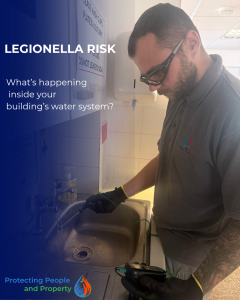
Most people rarely think about the water sitting inside a building’s pipework.
But when water becomes warm, stagnant or poorly managed, the conditions can become ideal for Legionella bacteria to multiply.
Legionella is found naturally in water, but the risk to people increases when it grows within purpose-built water systems, such as hot and cold water systems, showers, tanks, cooling systems, and other equipment capable of producing water droplets or aerosols.
When contaminated droplets are inhaled, the bacteria can cause Legionnaires’ disease, a potentially serious and sometimes fatal form of pneumonia.
For those responsible for workplaces, residential buildings and other premises, Legionella should therefore never be viewed as simply a water hygiene issue. It is a health and safety responsibility that needs to be actively managed.
Why can Legionella develop in building water systems?
A building does not need to be obviously dirty or poorly maintained for Legionella risk to exist.
The bacteria can multiply when conditions within the water system allow it.
The Health and Safety Executive identifies several factors that can increase the risk, including water temperatures that support bacterial growth, stored or recirculating water, stagnation and systems that are capable of producing breathable water droplets.
Legionella can particularly become a concern where:
• Water temperatures fall within a range favourable to bacterial growth
• Outlets or areas of the system are rarely used
• Water remains stagnant for extended periods
• Scale, sediment or biofilm has developed within the system
• Tanks, pipework or outlets are poorly maintained
• Showers, taps or other equipment create aerosols that can be inhaled
The HSE advises that Legionella bacteria can grow where water temperatures are between approximately 20°C and 45°C.
This is why controlling temperatures and preventing stagnation remain such important parts of Legionella management.
Stagnant water can create an unseen risk
One of the most common problems within water systems is stagnation.
Think about areas such as spare rooms, vacant properties, little used washrooms, seasonal buildings or outlets that have simply been forgotten.
Water can remain sitting within those sections of pipework for considerable periods.
Combined with warmer temperatures and the presence of nutrients, scale or biofilm, this can create conditions that allow bacteria to multiply.
Dead legs and redundant pipework can also create areas where water circulation is poor or virtually nonexistent.
Regularly reviewing the design and use of the water system is therefore essential.
Temperature control matters
Temperature remains one of the traditional methods used to control Legionella within hot and cold water systems.
Current HSE guidance states that cold water should, where possible, be maintained below 20°C.
Hot water should be stored at at least 60°C and distributed so that it reaches 50°C within one minute at outlets, with different requirements applying in some healthcare settings.
It is not enough simply to assume that the boiler or calorifier is operating at the correct temperature.
Temperatures need to be monitored at appropriate points throughout the system so that potential problems can be identified.
A hot water system may leave the plant room at the correct temperature but fail to maintain that temperature further along the distribution network.
That is exactly why ongoing monitoring matters.
What does ACoP L8 require?
Under the HSE’s Approved Code of Practice L8, duty holders are expected to properly manage the risk of exposure to Legionella.
This includes:
• Identifying and assessing potential sources of risk
• Appointing a competent responsible person
• Preparing a written scheme for preventing or controlling the risk where necessary
• Implementing and managing appropriate control measures
• Monitoring those controls
• Reviewing the arrangements
• Keeping appropriate records
The responsibility does not end once a Legionella risk assessment has been completed.
A risk assessment should form the basis of an ongoing management and control programme.
What should a good Legionella control programme include?
The exact requirements will depend on the building and water system, but effective control will commonly include:
Understanding the water system
Dutyholders should understand how water enters, moves around and leaves the building.
Up to date schematic drawings can help identify tanks, calorifiers, circulation loops, outlets and potential areas of stagnation.
Temperature monitoring
Hot and cold water temperatures should be checked at appropriate locations and frequencies in line with the system and its risk assessment.
Flushing little used outlets
Where outlets are not used regularly, an appropriate flushing regime may be required to prevent stagnation.
Managing dead legs and redundant pipework
Unused sections of pipework should be identified and, where reasonably practicable, removed.
Cleaning and maintaining the system
Scale, sediment, corrosion and biofilm can all contribute to conditions favourable to bacterial growth.
Water systems should therefore be appropriately inspected, cleaned and maintained.
Monitoring and record keeping
Temperature checks, flushing records, inspections, remedial works and other control measures should be documented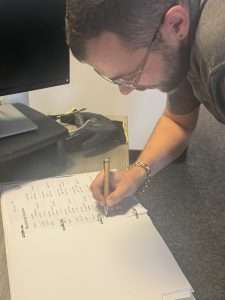
Good records help demonstrate that the control scheme is actually being implemented rather than simply existing on paper.
A Legionella risk assessment is only the beginning
One mistake we regularly see is treating a Legionella risk assessment as a one off exercise.
It should not be.
Buildings change.
Occupancy changes.
Outlets stop being used.
Pipework gets altered.
Water temperatures fluctuate.
Staff responsible for managing the system move roles.
The risk assessment and written control scheme should therefore remain live documents and should be reviewed whenever there is reason to believe they are no longer valid.
Could your building have an unmanaged Legionella risk?
Legionella risk is often created by ordinary operational issues rather than dramatic failures.
A forgotten shower.
A redundant section of pipework.
A cold water tank warming during summer.
An outlet that has not been used for months.
A temperature check that has gradually stopped being completed.
Individually these things may seem insignificant. Together, they can create exactly the conditions Legionella needs.
The key is knowing your water system, understanding where the risks are and making sure the agreed control measures are actually being carried out.
How Legionella & Fire Safe Services can help
At Legionella & Fire Safe Services, we work with organisations across the UK to help them understand, manage and document their Legionella responsibilities.
Our services include Legionella risk assessments, monitoring programmes, water sampling, temperature monitoring, remedial works, tank inspections and cleaning, TMV servicing and ongoing water hygiene support.
Whether you manage one property or a nationwide portfolio, our team can help you put practical controls in place and ensure your water management programme remains effective.
Do you know when your Legionella risk assessment was last reviewed?
If you are unsure whether your current water hygiene arrangements are still suitable, speak to our team.
Info@legionellaandfiresafe.co.uk
0800 080 3045
Protecting people. Supporting compliance. Managing risk.


