
Recent reports within the fire safety sector continue to highlight a concerning trend across residential buildings. Serious fire safety failures are being identified not because standards have changed, but because they were never properly checked in the first place.
The cases outlined below have been reported within the industry and reflect issues uncovered through external reviews, contractor investigations and compliance challenges faced by managing agents and building owners. While the buildings differ in size and layout, the themes are strikingly consistent.
What these reports show, very clearly, is how quickly risk increases when assessments are carried out by unqualified individuals, when contractor activity is not independently reviewed, or when cost and convenience are allowed to override competence.
For those responsible for residential buildings, the message is simple. Fire safety cannot be assumed. It must be properly assessed, verified and challenged.
Case Study One
Systemic Fire Safety Oversight Failures in a Five-Storey Residential Block
A reported investigation into a purpose-built five-storey block of flats identified two significant fire safety failings that had gone undetected for several years.
Issue One. Inadequate Fire Risk Assessment
For a number of years, the building’s annual Fire Risk Assessment was carried out internally by an employee of the managing agent. While they held a general health and safety role, they were not a qualified or third-party accredited fire risk assessor.
As a result, critical fire safety issues were repeatedly overlooked, including the absence of fire stopping within risers and service penetrations. These openings created clear routes for fire and smoke to spread rapidly throughout the building.
This was not a technical oversight. It was a failure of competence.
Issue Two. Poor Oversight of Servicing Contractors
Fire alarms, dry risers, and automatic-opening vent systems were maintained by a large national contractor. However, there was no evidence of meaningful oversight to confirm whether works had been completed correctly or whether escalating repair costs were justified.
The reported investigation highlighted that operatives were incentivised through commission-based additional works, resulting in inflated quotations and unnecessary repairs.
One example cited a £1,000 quote to repair an automatic fire door. A subsequent inspection found the issue to be a disconnected wire, resolved in under 30 minutes with no replacement parts required.
Reported Findings
When the situation was reviewed, the following issues were identified:
• Missing fire stopping in risers and service penetrations
• Incorrect and misleading fire safety signage
• Significant gaps in compliance documentation and contractor management
These were long-standing issues that should have been identified much earlier through competent assessment.
Reported Outcome
A comprehensive remedial programme was implemented, which included:
• Reinstatement of compliant fire stopping
• Correction of fire safety signage
• Improved contractor oversight and servicing controls
The building now operates with a compliant Fire Risk Assessment carried out by a third-party accredited assessor and a clearer, more accountable approach to fire safety management.
Key Lessons From Case Study One
• Fire Risk Assessments must be completed by qualified, third-party accredited assessors
• Internal assessments without demonstrable competence create risk
• Contractor works must be verified, not assumed
• Repeated or high-cost repairs should always be challenged
Case Study Two
Fire Door Survey Failures and Avoidable Financial Risk
Recent reports on fire door surveys have highlighted how poor reporting and a lack of independence can lead to unnecessary expenditure and a false sense of compliance.
Survey One. Small Residential Block
A reported case involving a small block of six flats, all opening onto a single escape stairway, raised

immediate concerns. The fire door survey was signed off by an individual identified only by a first name, with no qualifications or company details provided.
The report recommended installing intumescent strips and replacing the final exit door.
A subsequent review found:
• Flat entrance doors had excessive gaps
• No self-closing devices were installed
• Letter plates were non-intumescent
• The final exit door was fully compliant and did not require replacement
Given that all flats opened onto the sole means of escape, the real risks were within the flat entrance doors, not the final exit.
Survey Two. Larger Residential Block
A separate reported case involved a fire door survey covering 42 doors within a larger residential block. Every door was failed without explanation or supporting evidence.
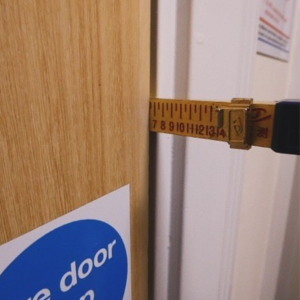
When challenged, the surveying company stated that the doors did not meet current regulations but refused to provide certification references or technical justification. A linked contractor subsequently issued a £65,000 quotation for full door replacement.
Further independent review of the situation, as reported within the sector, found that only a small number of doors required replacement. The majority were certified fire doors that could be brought back into compliance through minor remedial works.
The reported final cost of achieving compliance was under £20,000, avoiding more than £45,000 in unnecessary expenditure while addressing genuine fire safety concerns.
The Key Message
These reported cases demonstrate a recurring issue within residential fire safety management. Poor quality surveys, vague reporting and commercially influenced recommendations do not improve safety. They increase risk and cost.
Fire safety decisions must be based on evidence, competence and independence.
Final Takeaways
• Always appoint qualified, third-party accredited fire risk assessors and fire door inspectors
• Verify servicing and remedial works with evidence, not invoices
• Challenge vague, unsupported or excessive reports
• Independent oversight protects lives, ensures compliance and delivers value
If you are unsure who carried out your last assessment or whether their findings were properly justified, that is the moment to ask questions.
Because when it comes to fire safety, assumption is the greatest risk of all.
Need Clarity on Your Fire Safety Compliance?
If you are responsible for a residential building and are unsure whether your Fire Risk Assessment, fire door inspections or servicing arrangements are appropriate, qualified and fully compliant, it may be time for an independent review.
Legionella & Fire Safe Services Ltd works with managing agents, landlords and housing providers to support compliant, transparent and accountable fire safety management.
If you would like to speak to our team or simply have a conversation about your current arrangements, please get in touch. We are always happy to advise.
Call: 0800 080 3045
Email: info@legionellaandfiresafe.co.uk
Disclaimer
The case studies referenced in this article are based on reported examples within the fire safety sector. They are provided for information and awareness only and do not relate to assessments, surveys or investigations carried out by Legionella & Fire Safe Services unless expressly stated.


